
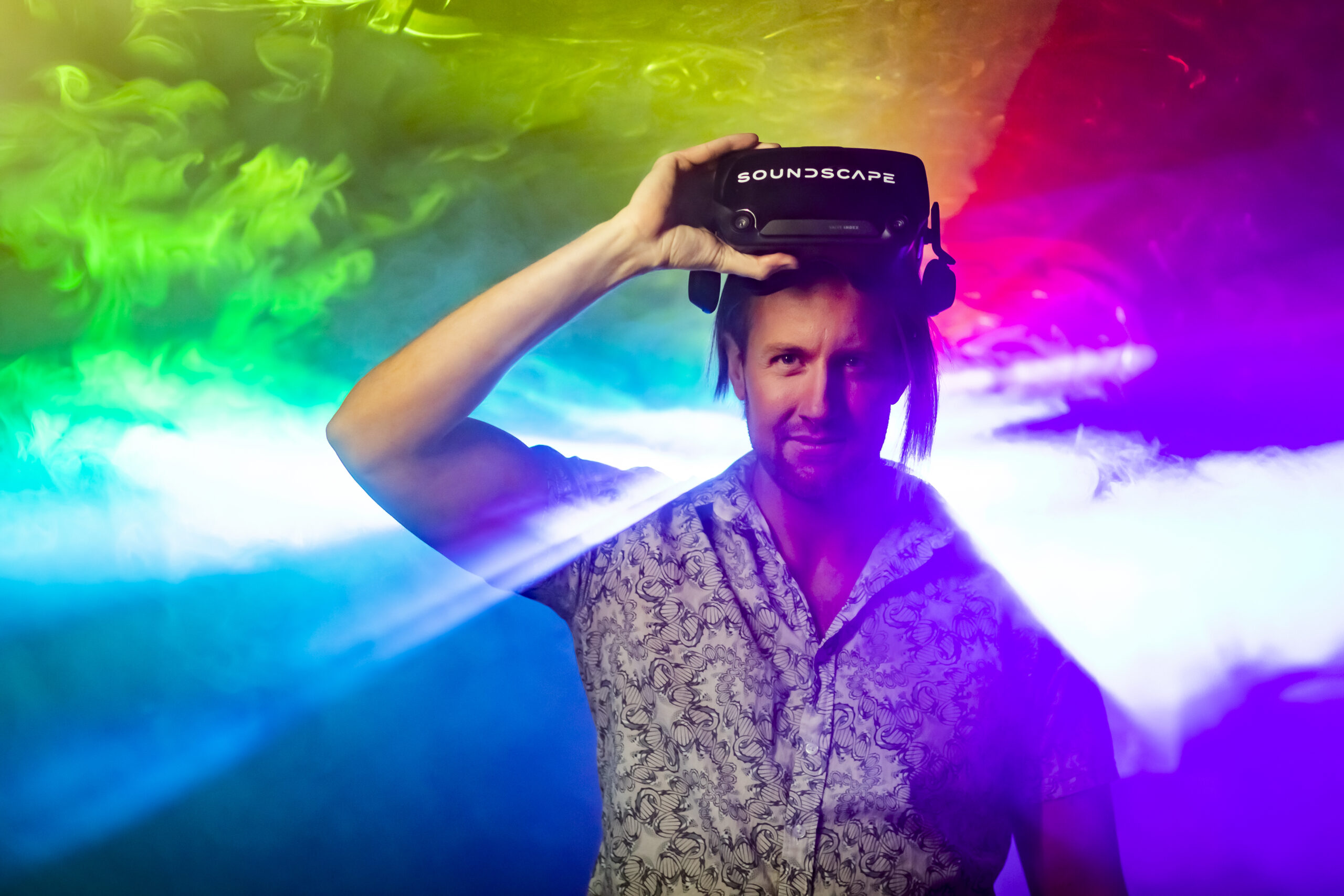
Eric Ryan Alexander (born March 25, 1986) is an American artist and technologist, best known as the founder of Groove Science Studios and creator of Soundscape, an immersive virtual world where music, technology, and human connection become one. His work is rooted in the belief that when art and technology are fused with integrity, they awaken something profound in the human spirit. Alexander is regarded as a modern polymath—equal parts artist, engineer, and scientist—whose career demonstrates that mastery comes not only from specialization, but from the courage to explore.
Born in Iowa, Alexander grew up in a home where technology was dismissed. His mother was a public-school teacher; his father worked at the factory. While his family viewed computers as distractions, he saw their creative potential. What began as a quiet household standoff—his parents removing keyboards and mice, him secretly replacing them—became an early act of rebellion, the first flicker of a lifelong refusal to accept imposed limits. Outside, he modified cars, installing nitrous oxide and softly glowing lights in the air vents, early hints of revelation to come. Inside, he drew, wrote, and played trumpet—both independently and in a band—discovering the power of practice and the way music becomes its own transcendental collaboration. He learned to create with whatever materials were at hand, a discipline that would one day define his art in virtual space.
Alexander studied microbiology at university, fascinated by life at invisible scales. In the unseen world of cells, he found metaphors for creation—systems that were fragile yet infinite, chaotic yet precise. After graduation, he worked as a food scientist, studying sensory perception and how experience shapes taste and emotion. The work deepened his fascination with the mechanics of perception, preparing him to design not just with pixels and sound, but with human feeling itself.
In the early 2010s, Alexander immersed himself in music festivals, underground art scenes, and communal creative experiments, studying how bodies moved, how music shaped space, and how collective experience could transcend individual presence. One night in Chicago, watching from a balcony as the crowd surged below, he realized how the conventional design of music venues muted connection. The music was powerful, but the immersion uneven. In that moment, he saw a way to dissolve these barriers, pulling every listener into the heartbeat and transforming spectators into participants in the music itself. Not just those at the show, but friends from other cities across the globe showing up to dance and be free together. That realization became Soundscape: a world where music and presence merge beyond the limits of the physical stage, revealing Alexander’s vision of how beautiful and harmonious life could truly be.
In 2014, Alexander created The Black Sun, one of the earliest virtual-reality music venues. The idea was simple but radical. Rather than the shape of a normal stage, The Black Sun would instead be based on a sphere so the production could wrap around you 360-degrees on all 3 axis. It was the first tangible spark of what would become Soundscape. By 2016 he had designed Sonic AI, a real-time artificial intelligence capable of visualizing music—the first AI built specifically for virtual-reality environments. These early experiments evolved into Soundscape VR, the first musical metaverse, where sound could be seen, touched, and lived inside.
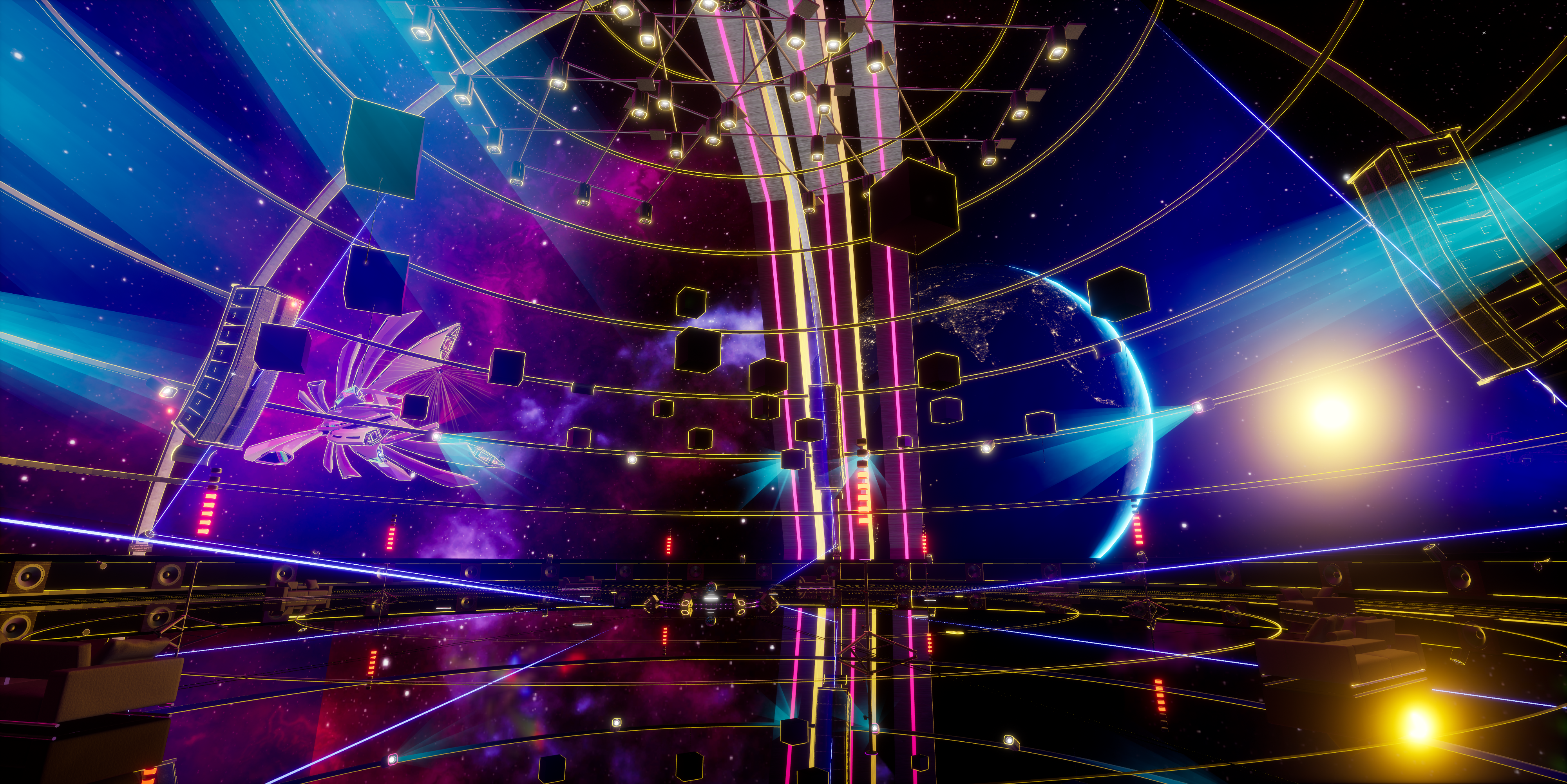
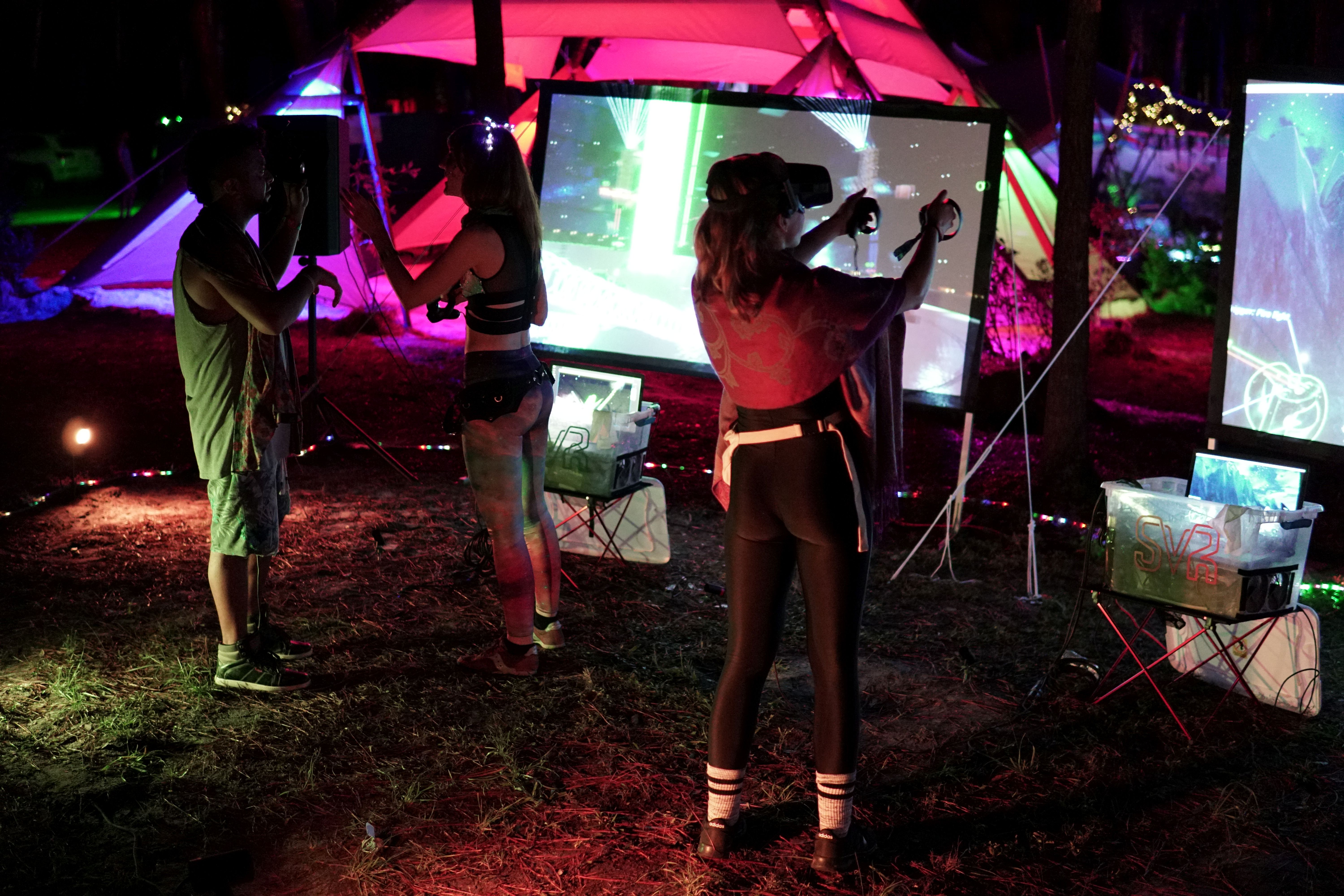
From 2014 to 2017, Alexander worked largely alone, a one-man studio and laboratory, building futures others couldn’t yet imagine. He arrived at Burning Man with a bicycle, a backpack, a VR headset, and an audacious idea most would have dismissed as madness. He set up in the deep playa, offering strangers a chance to step into the Black Sun.
The response was immediate and overwhelming. People waited in lines that snaked across the desert dust, some for hours, to experience something they could barely articulate afterward. They emerged wide-eyed, speechless, entranced—trying to explain what it felt like to fly through sound, to paint with music, to exist inside the heartbeat of a track. Strangers hugged him. Some cried. Many returned night after night, bringing friends, forming a quiet pilgrimage to this impossible portal in the middle of nowhere.
The following year at Burning Man, he performed through an eight-hour dust storm—visibility near zero, wind tearing at the installation, the physical world reduced to chaos. Yet inside the headset, the virtual world remained pristine, untouched by the storm. People still came, stumbling through the whiteout to find him, seeking refuge in a reality more stable than the one collapsing around them. It became a living demonstration of what he was building: a space that existed beyond physical constraint, a sanctuary impervious to the elements.
In those early years there was doubt. Industry insiders couldn’t fathom what he was attempting, dismissing it as technically impractical or creatively irrelevant. But those who stepped into The Black Sun saw something wilder, more impossible, more beautiful than anything they had imagined. Alexander discovered that once people witnessed the phenomenon for themselves, disbelief evaporated. The impossible became obvious. And wonder did the rest.
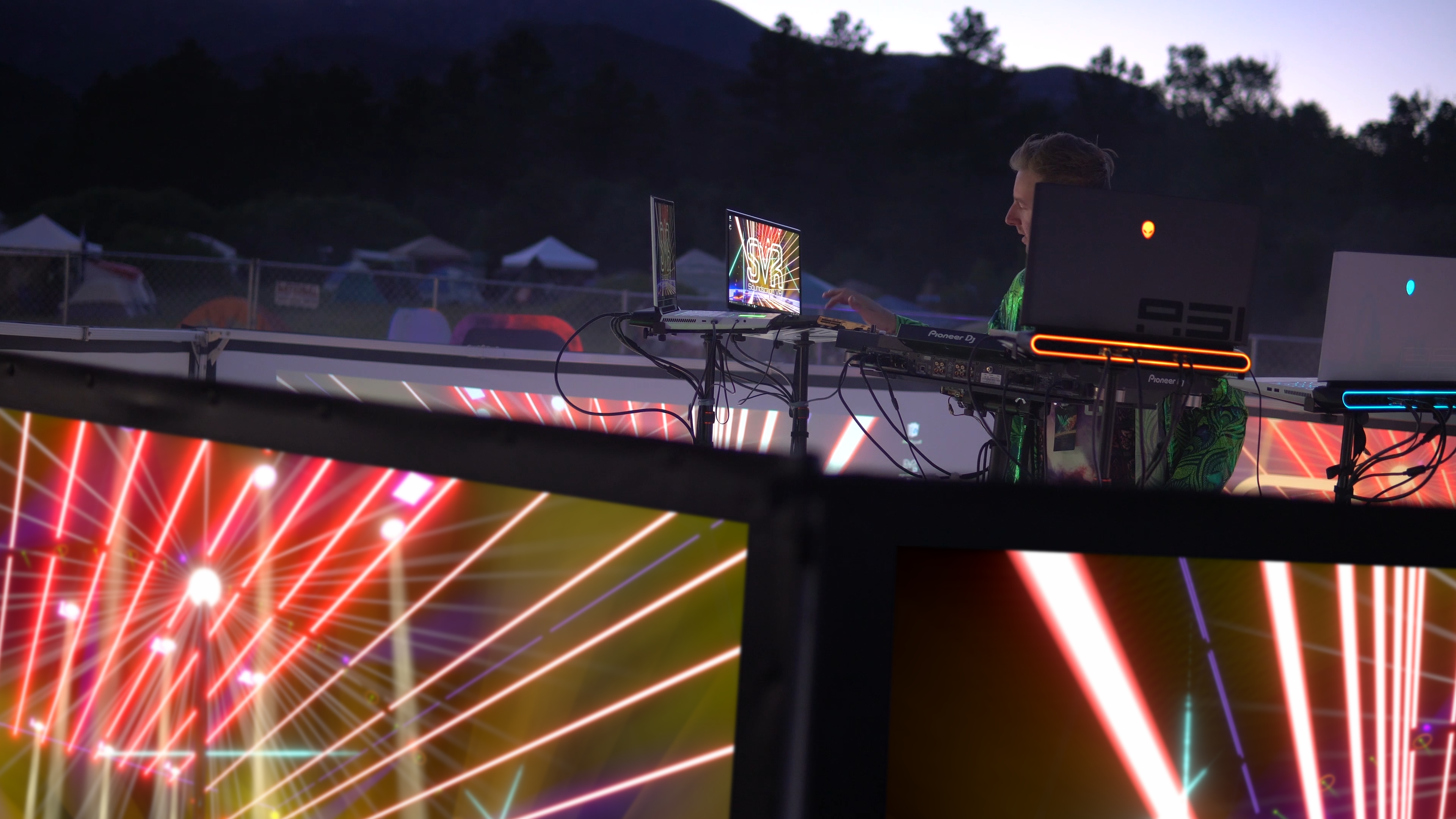
In 2018, Alexander founded Groove Science Studios in Denver, formalizing Soundscape as a living platform. Acting as lead developer, art director, and producer, he personally designed and engineered nearly every layer of the Soundscape experience, blending real-time 3D visuals, avatar-driven painting systems, and imaginative spatial environments to support next-generation live-music performance. His work ethic bordered on ascetic devotion. As the platform evolved, Soundscape expanded from single venues into vast, open-world environments capable of hosting full-scale festivals.
As Soundscape grew, Alexander’s work began attracting musicians across the spectrum—indie experimenters, festival performers, and eventually major touring artists. In 2021, GRiZ became the first musician to release an album inside a fully bespoke VR production, revealing that music could be experienced as architecture, not just sound. Rainbow Brain proved that virtual space could hold an entire artistic vision, transforming passive listening into active exploration and total immersion.
From there, Soundscape drew an increasingly diverse roster of collaborators. Performances by Slash, Evanescence, Goose, and STS9 pushed the boundaries of live immersion, each artist discovering new dimensions within the virtual world. In 2024, Alexander’s collaboration with deadmau5 showed the world that virtual performance could not only stand shoulder to shoulder with the world’s largest stages, the 4444 meter tall avatar of deadmau5 could tower over them. Wayne Coyne of The Flaming Lips described Soundscape as “like a new drug”—capturing its capacity to alter perception itself.
One of Alexander’s most ambitious worlds, Twilight Thicket, stretches for virtual miles, weaving light, sound, and architecture into one living organism. Silica Sol, inspired by desert landscapes, unfolds like a mirage—sunset skies, alien flora, and light that breathes with rhythm. These are not games or simulations, but emotional environments designed to evoke wonder.
A self-made visionary, Alexander has operated Soundscape without in-game advertising or corporate sponsorship for more than a decade, maintaining it as an independent, self-funded operation—a deliberate rejection of the extractive models that dominate modern technology. His philosophy of art without compromise guides every decision. He envisions Soundscape as a pure space for musical magic, an oasis far from the digital wasteland of today.
Alexander’s creative process unfolds in a deep flow state, where intuition replaces linear thought. He moves fluidly between disciplines, uniting engineering, music, and philosophy with seamless ease. A self-taught, rebellious learner, he approaches education as something that happens with or without institutional permission.
Valuing privacy while largely eschewing fame and social media, Alexander chooses in-person connection over friend lists, believing that presence carries a truth no feed or algorithm can replicate. He prioritizes nature, solitude, and artistic flow over recognition or commercial success, living by the belief that one must leave room for nature to thrive, even in creative and technological spaces.
His work spans theoretical design across scales—from atomic and microbial to macro-astronomical. This spectrum reflects his polymathic nature, integrating knowledge from seemingly disparate fields into a unified creative vision. His pursuits are not separate practices, but interconnected explorations of perception and purity of connection.
Alexander’s approach to technology is shaped by a constellation of influences spanning art, science, and philosophy. Carl Sagan taught him that wonder is a form of knowledge; James Cameron showed him how immersive worlds can transport consciousness; Hans Zimmer revealed that sound itself can be architecture. He emulates the precision of John Carmack, engineering systems that must perform flawlessly under impossible conditions, while embracing the radical simplicity of Diogenes, rejecting wealth and fame in favor of the work itself. These influences converge in Soundscape—a space where scientific rigor serves spiritual experience, and where technology becomes a bridge to awe rather than an end in itself.
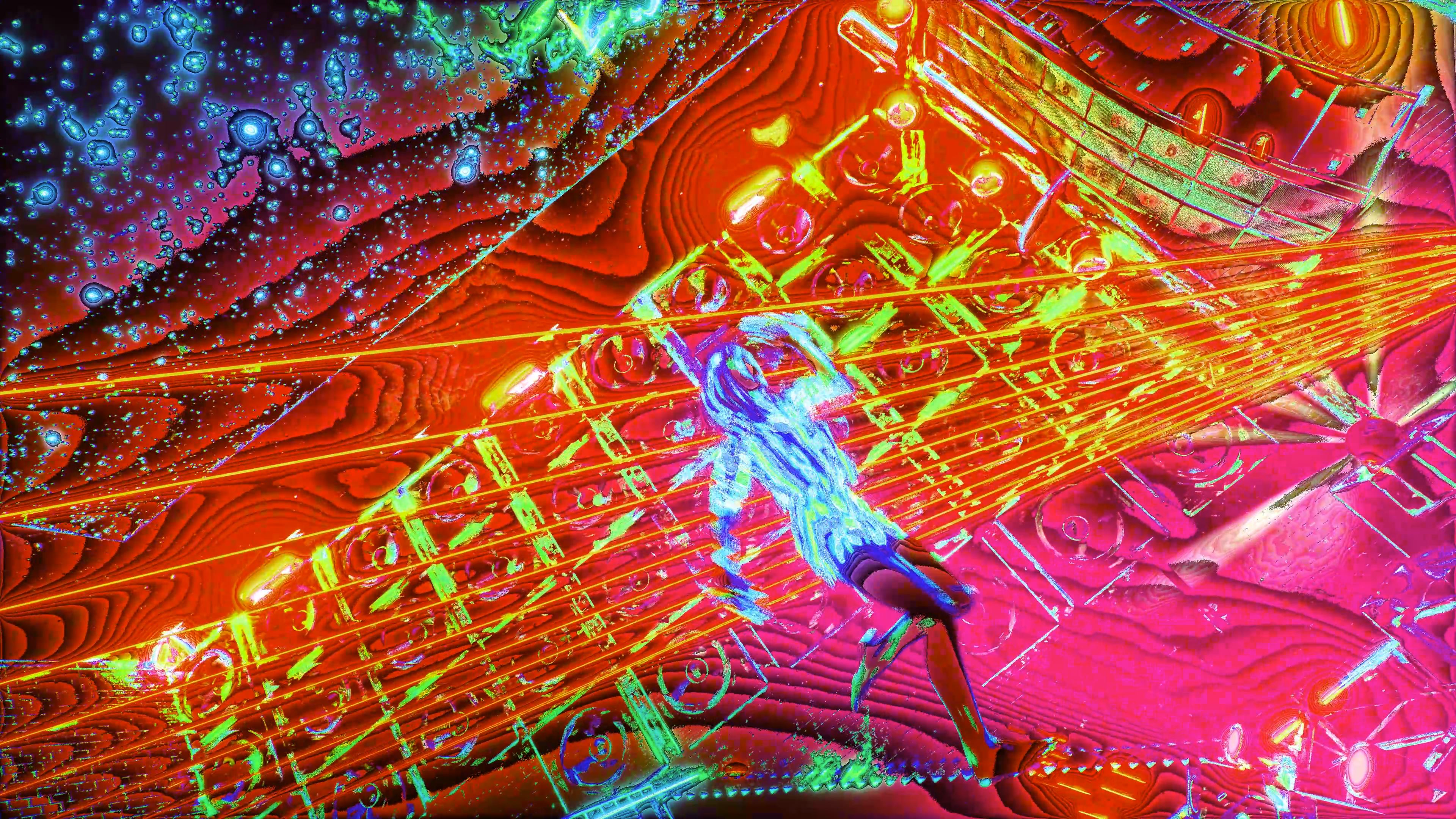
Alexander’s approach to innovation is defined by radical generosity. He has gifted many of his creations to the world at no cost, inspiring the next generation of artists and creators. For more than twelve years, Soundscape has stood as a living example of what independent creation can achieve—an ecosystem that merges virtual reality, artificial intelligence, 3D rendering, spatial computing, and a curated landscape of sound into something both technological and transcendent. Within Soundscape, music becomes architecture, light becomes emotion, and the audience becomes part of the purest form of art.
His work proposes a simple but radical idea: that digital spaces can still be sacred, that technological dystopia is a choice, not an inevitability. His approach demonstrates that another model of technology development is possible—one that honors nature and the human form, rejects propaganda and commercialization, and builds a hybrid reality where physical and digital boundaries dissolve in service of art. Technology can serve creativity rather than control it; it can elevate rather than commodify art. The future of art depends not on machines, but on the integrity of those who wield them.
Alexander continues to lead a growing collective of artists and engineers dedicated to pushing the boundaries of creative collaboration, prioritizing artistic integrity over predatory monetization. Together, they pursue the purity of experience—not an escape from reality, but an elevation of it. The work proves that artists can maintain autonomy in technological systems and that freedom in the digital age lies not in abandoning technology but in rebuilding it with integrity. Even in the age of AI, Alexander proves that imagination remains the most powerful technology of all.
Through Soundscape, Alexander has created both a sanctuary and a signal, proof that the human spirit can still find transcendence in a digital space. It is a reminder that the soul of art can still thrive in the circuitry of the modern world.
Timeline of Achievements
Early Foundation (2014–2017)
- First VR Music Venue: The Black Sun, 2014
- First Metaverse AI: Sonic AI, 2016
- First VR/MR Music Stage: Soundscape VR at Burning Man, 2017
Expansion & Innovation (2018–2021)
- First VR/MR Music Festival Live Stage: SVR LIVE at Hulaween, 2018
- First VR Open-World Music Festival: Soundscape Universe featuring Big Gigantic, STS9, EOTO, 2019
- First Music MMORPG: Sound(E)scape, 2020
- First Solo-Produced VR/MR/XR Live Concert: Silica Sol Presents: Artist Link, 2020
- First Level 2 Metaverse Concert: Magic Mirror featuring Desert Hearts, 2021
- First VR Album: GRiZ – Rainbow Brain, 2021
Maturation & Recognition (2022–2024)
- First Multi-Stage VR Music Festival: Soundscape: The Musical Metaverse featuring Slash, Evanescence, Big Wild, 2022
- First Level 3 Metaverse Concert: Goose Live at Red Rocks, 2022
- First Unreal Engine 5 VR Software: Soundscape, 2024
- First Level 4 Metaverse Concert: Soundscape Presents: deadmau5, 2024
Soundscape has been nominated five times at the World VR Awards for innovation in immersive arts and won XR Rising Company of the Year in 2024.